The game
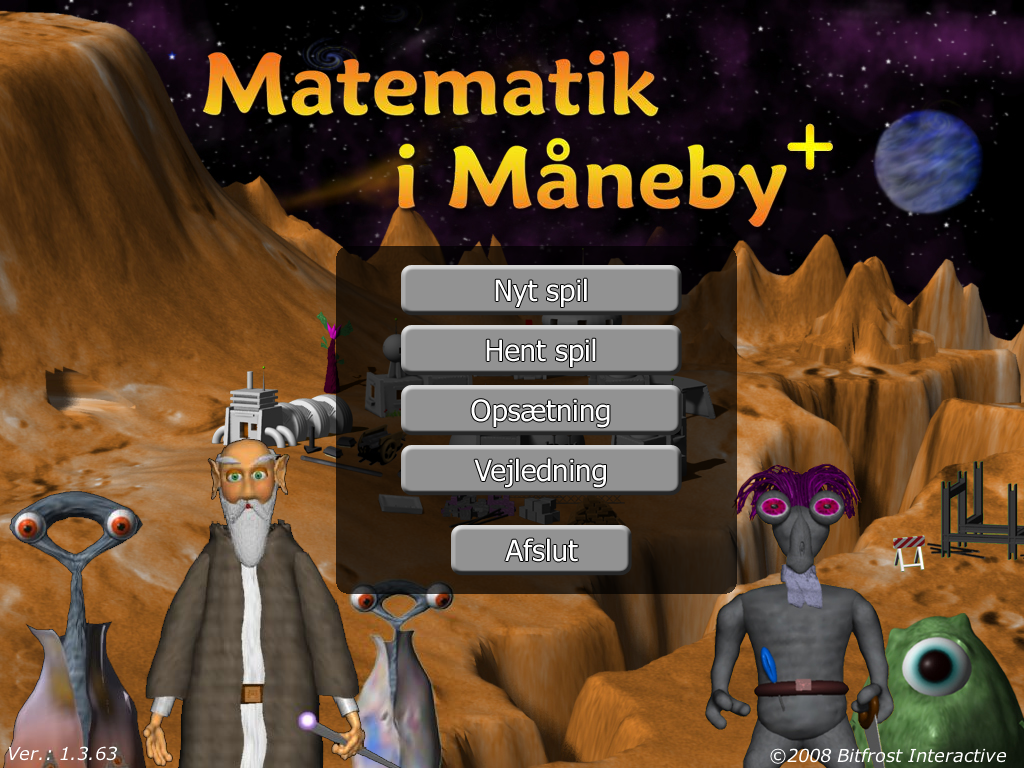
Matematik i Måneby is a maths program in the adventure game genre for Windows, released on CD-ROM by Bitfrost Interactive in 2005. The player is the builder, a "calculator" who has to help a band of aliens build an entire town in a deserted lunar landscape: houses, bridges, flowerbeds, street lights and much more.
How it plays
Maths problems are hidden under every building. Get them right and the structures turn out handsome and solid; get them wrong and they end up smaller or shaky. How detailed the town becomes depends directly on how well the pupil does, and that is what drives the whole game: a finer town takes better maths.
The game is non-linear. You choose which parts of the town to build and in which order, and there is no fixed route through the problems. Along the way you are accompanied by a wizard-like wise old man who reads every text aloud and offers help, so that pupils who cannot yet read confidently can join in too. The game is fully voiced, with animation and music.
School years and problem types
Before the game begins, you can pick the school year and the types of problem so the content suits the pupil, and the difficulty rises with the school year. The sources give the target group as 1st to 6th grade or 3rd to 6th grade; the plus edition probably covered the widest range. The maths covered includes:
- The four operations of arithmetic
- Geometric shapes, area and volume
- Fractions, ratios and percentages
- Isometric drawing
- Pie charts and bar charts
- Equations
For the teacher, the pupil's progress is logged automatically to a log file, so the work done in the game can be followed up in class.
Five languages on one disc
Every single edition of the game contains five complete language versions: Danish, English, Swedish, Norwegian Bokmål and Nynorsk. You switch between them with the flags at the bottom of the setup menu, and the switch covers everything: menus, instructions, task names and the recorded voice-over. So Swedish and Norwegian were not just translated, but voiced by actors as well.
The English version is the strangest find in the files. It is just as finished as the others and has its own title artwork under the name MoonVille Math, yet its flag is switched off by default, so almost nobody has seen it. There is no trace of an English release anywhere, not in shops, not in reviews, not among fans. Most likely the translation was got ready for international sales that never happened, and it has been hidden in every copy sold ever since.
The technology behind it
The game is built in Macromedia Director, the tool of choice for CD-ROM multimedia at the time, and programmed in Director's own language, Lingo. It was a sensible decision for a team of five: the designers could put graphics, animation and sound together on a timeline themselves, while only the actual game mechanics needed code. It is also, however, the reason the game stopped working. Adobe abandoned Director and the Shockwave player, and the technology no longer exists in modern operating systems and browsers.
By far the largest part of the roughly 300 megabytes is not code but content: almost 1,700 images and over 2,500 sound clips with music, effects and the wise old man reading every single task aloud in several languages.
Versions
The game came out in several editions between 2005 and 2011, both on CD-ROM and online, and from the plus edition onwards under the name Matematik i Måneby+. The preserved and documented versions:
| Edition | Version | Year | Note |
|---|---|---|---|
| Matematik i Måneby (basic) | unknown | 2005 | The original edition, launched in September 2005 |
| Matematik i Måneby+ | 1.3.63 | c. 2008 | CD-ROM; also exists as a UNI-C SkolePro edition |
| Matematik i Måneby | 1.4 | unknown | Preserved as an ISO |
| Matematik i Måneby+ | 1.4.5.96 | 2010 | Latest known version |
Years and version numbers for the plus editions come from Internet Archive metadata and are being checked against the original discs as we go. See the sources on the History page.